Home  /  All-on-X Solutions

All-on-X Full-Arch Implants in Newnan, GA

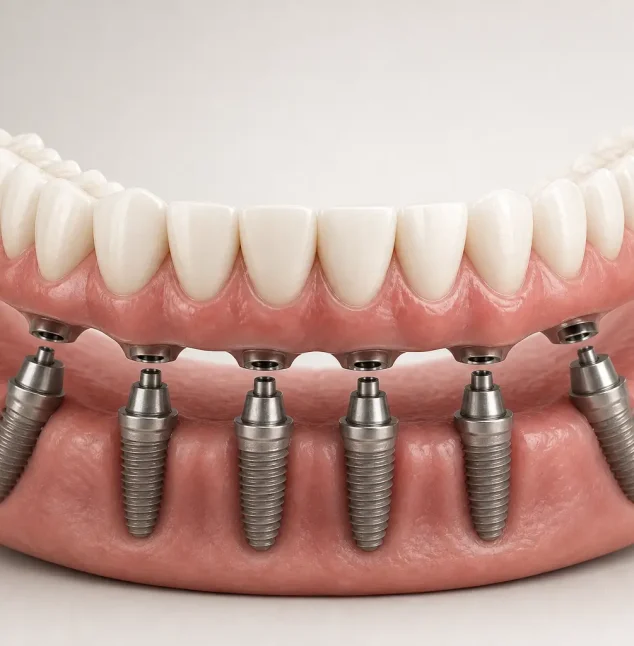
Fixed full-arch All-on-X bridge aligned over six dental implants

All-on-X is a fixed full-arch treatment concept for replacing an entire upper or lower row of failing or missing teeth with one bridge supported by several dental implants. The restoration stays in your mouth; only a dental professional removes it when clinically necessary.

What Does “All-on-X” Mean?

“All” refers to all replacement teeth in one arch. “X” means the implant number is selected for the patient rather than promised in advance. Many designs use four to six implants, but anatomy, bone quality, bite forces, restorative material, opposing teeth, and the desired safety margin can support a different plan.

All-on-X is an umbrella term, while “All-on-4” is commonly used for a specific four-implant approach. Fewer implants are not automatically better, and additional implants are not automatically necessary. A prosthetically driven plan begins with the final teeth and works backward to implant positions that can support them.

Fixed does not mean maintenance-free

A fixed full-arch bridge does not come out for routine home cleaning, but food and plaque can still collect underneath it. Daily cleaning below the bridge and ongoing professional implant maintenance are essential, and teeth, screws, or framework components can eventually need repair or replacement.

Potential Benefits of a Fixed Full-Arch Bridge

Fixed stability

The bridge is secured to implants and does not lift out like a removable denture during everyday speaking and chewing.

One coordinated arch

Tooth position, bite, smile display, and the transition between the bridge and gums are planned together for the full upper or lower arch.

Efficient implant support

Strategic placement, sometimes including tilted posterior implants, may use available bone efficiently. This can reduce grafting in selected cases but does not eliminate grafting for everyone.

No daily removal

Many patients prefer replacement teeth that remain in place. The tradeoff is that cleaning underneath requires specific tools and consistent technique.

Fixed All-on-X vs. Removable Implant Overdentures

Feature Fixed All-on-X bridge Removable implant overdenture
Who removes it Dental professional, when clinically needed Patient, every day for cleaning
How it connects Usually screw-retained to multi-unit implant abutments Snaps onto locator or bar attachments
Home hygiene Clean underneath with floss threaders, small brushes, water irrigation, or other prescribed aids Remove the denture and clean it, the attachments, implants, and gums
Facial support Often uses a slimmer fixed design; support depends on anatomy and tooth position A removable flange can sometimes replace more lost gum volume and lip support
Repairs and service Screws, teeth, acrylic or ceramic, and framework may require service Attachment inserts, denture teeth, acrylic, relines, and the denture may require service

How Oak Hill Plans Full-Arch Treatment

A full-arch decision should never begin with a package or implant count. Dr. Mike Jin evaluates whether teeth can be predictably preserved, treats active disease, reviews medical and medication risks, studies your bite and smile, and uses 3D cone-beam CT imaging when appropriate to assess bone and important anatomy.

1

Diagnosis and alternatives

We identify which teeth are maintainable, discuss conventional dentures and removable implant dentures, and explain whether care should be coordinated with a surgeon or prosthodontic specialist.

2

Digital and restorative planning

3D imaging, scans, photographs, records, and bite information guide the proposed tooth position, implant distribution, restorative space, and cleansable contours.

3

Surgery and provisional teeth

Necessary extractions and implants are completed according to the plan. A fixed provisional bridge may be possible the same day only when implant stability, bite, and other clinical conditions are favorable.

4

Healing and final bridge

After integration and tissue healing, new records are used to refine fit, bite, speech, appearance, hygiene access, and material for the definitive full-arch bridge.

Immediate Teeth: What “Same Day” Can—and Cannot—Mean

Some patients can leave implant surgery with a fixed provisional bridge. That is not the final bridge, and immediate loading is not guaranteed. It depends on adequate implant stability, bone quality, implant distribution, bite control, overall health, and the ability to follow a soft-diet protocol.

If immediate fixed teeth are not safe, a removable healing prosthesis or another temporary approach may be recommended. The priority is predictable healing, not forcing every patient into the same timeline.

Candidacy, Risks, and Alternatives

All-on-X may be considered when an arch is already without teeth or the remaining teeth have a poor long-term prognosis. It should not be used to justify removing restorable natural teeth without a clear diagnosis and informed discussion. Smoking, uncontrolled diabetes, active gum disease, limited bone, grinding, certain medications, and difficulty maintaining hygiene may increase risk or change the plan.

Potential complications include pain, swelling, infection, nerve or sinus injury, failure of an implant to integrate, gum or bone inflammation around implants, food trapping, speech adaptation, loosening or fracture of screws and prosthetic components, and the need to remake or replace a bridge over time. Alternatives can include preserving and restoring natural teeth, a conventional denture, a removable implant overdenture, or another implant-supported bridge design.

Cleaning and Long-Term Follow-Up

  • Brush the bridge and implant transition areas at least twice daily with the tools recommended for your design.
  • Clean underneath the full arch every day with floss threaders, interdental brushes, a water flosser, or other prescribed aids.
  • Wear a night guard if recommended to manage grinding or heavy bite forces.
  • Keep professional implant-maintenance visits on the risk-based interval recommended for you; full-arch restorations need lifelong monitoring.
  • Call promptly for new movement, a changed bite, persistent soreness, bleeding, swelling, bad taste, fracture, or difficulty cleaning an area.

Get a Full-Arch Plan Built Around You

Oak Hill Family Dentistry can explain whether a fixed All-on-X bridge, removable implant overdenture, conventional denture, or tooth-preserving plan best fits your health, anatomy, priorities, and maintenance ability.

Request an Implant ConsultationCall 770-251-8767

Patient information: This page provides general education and is not a diagnosis or guarantee of implant number, immediate teeth, grafting needs, candidacy, timing, cost, comfort, or outcome. Recommendations can be made only after an in-person examination and appropriate imaging.

All-on-X Full-Arch Implant FAQs

What is an All-on-X dental implant solution?

All-on-X replaces one complete upper or lower arch with a single fixed bridge supported by several dental implants. The patient does not remove the bridge for routine cleaning; a dental professional removes it only when maintenance or treatment requires access.

What does the X in All-on-X mean?

The X represents the case-specific number of implants used to support the full arch. Four to six implants are common designs, but the final number depends on bone anatomy and quality, implant distribution, bite forces, restorative material, opposing teeth, and the planned bridge.

Is All-on-X the same as All-on-4?

All-on-X is a broader term for a full arch supported by an individualized number of implants. All-on-4 commonly describes a four-implant approach; an examination and 3D plan should determine the implant number rather than fitting every patient into a four-implant package.

Are All-on-X teeth fixed or removable?

They are fixed for the patient and are usually secured with prosthetic screws to implant abutments. Fixed does not mean permanent or maintenance-free—the bridge and its components can wear or need repair, and a dental professional can remove it when clinically necessary.

Can I get fixed teeth the same day as implant surgery?

Some patients can receive a fixed provisional bridge on the day implants are placed, but immediate loading is not guaranteed. It requires adequate implant stability, favorable bone and implant distribution, controlled bite forces, appropriate health, and commitment to a soft diet and follow-up care.

Are the same-day teeth my final bridge?

Usually not. Same-day teeth are generally a provisional restoration used during healing; after the implants integrate and tissues stabilize, new records are taken to refine the fit, bite, appearance, speech, hygiene contours, and material of the definitive bridge.

Who is a candidate for All-on-X?

It may be considered when an arch has no teeth or the remaining teeth have a poor long-term prognosis, and the patient can tolerate treatment and maintain the restoration. Candidacy requires a clinical examination, medical review, gum evaluation, bite analysis, and 3D imaging because smoking, diabetes control, medications, grinding, and hygiene ability can alter risk.

Do all remaining teeth have to be removed?

No. Natural teeth that can be predictably maintained should be evaluated as part of the treatment-planning discussion; a full-arch implant bridge should not be used as a reason to remove restorable teeth without a clear diagnosis, alternatives, and informed consent.

Will I need bone grafting for All-on-X?

Strategic implant placement can reduce grafting in selected cases, but it does not eliminate grafting for everyone. Cone-beam CT imaging shows bone height, width, density, nerve position, and sinus anatomy so the team can discuss grafting, implant angles, or alternative designs.

Can All-on-X be done on the upper jaw, lower jaw, or both?

A fixed full arch can be planned for the upper jaw, lower jaw, or both arches. Upper and lower jaws differ in bone quality, anatomy, space, smile display, and bite forces, so implant number and design may not be identical between arches.

How long does full-arch implant treatment take?

The complete process often takes several months from diagnosis through definitive teeth. Extractions, grafting, healing response, whether immediate provisional teeth are possible, laboratory steps, and adjustments to bite and tissue contours all affect the schedule.

How do I clean under an All-on-X bridge?

Clean the bridge and gumline twice daily and clean underneath every day using the tools selected for your design, such as floss threaders, interdental brushes, or a water flosser. Professional implant maintenance remains essential because plaque and inflammation can develop even though the teeth do not decay.

What can I eat with All-on-X teeth?

A fixed full arch can provide strong function after healing, but the provisional phase usually requires a soft diet to protect integrating implants. Even with the final bridge, avoid using the teeth as tools and follow specific guidance for very hard or sticky foods and any grinding habit.

What materials are used for the final full-arch bridge?

Common designs use acrylic or composite teeth over a metal framework, high-performance polymer or titanium frameworks, or monolithic/segmented zirconia-based restorations. Material selection depends on restorative space, bite, repairability, appearance, weight, hygiene contours, laboratory design, and cost.

How long do All-on-X teeth last?

There is no guaranteed lifespan. Implants can function for many years with healthy tissues and good care, while prosthetic teeth, screws, access fillings, or framework can loosen, wear, chip, or fracture and may need maintenance, repair, or eventual replacement.

What are the risks and complications of All-on-X treatment?

Risks can include infection, pain, swelling, nerve or sinus injury, implant integration failure, inflammation or bone loss around implants, speech or bite adaptation, food trapping, and loosening or fracture of prosthetic parts. Your consent discussion should address risks specific to your medical health, anatomy, and proposed design.

How much does All-on-X cost, and is it covered by insurance?

Cost varies with the diagnostic records, extractions, grafting, implant number, provisional and definitive restorations, material, anesthesia or sedation needs, and specialist coordination. Insurance may cover portions but often has annual limits or exclusions; Oak Hill can provide an itemized estimate and discuss financing after the treatment plan is complete.

How do I choose between All-on-X and a removable implant denture?

A fixed bridge may feel more like teeth and does not come out daily, while a removable overdenture is often easier to clean and can replace more lost gum volume for facial support. The best choice depends on anatomy, dexterity, hygiene access, lip support, bite, maintenance preferences, treatment complexity, and budget.

Other Services

We Provide Amazing Services.

Local dental care for Newnan and nearby communities

Oak Hill Family Dentistry helps patients searching for a dentist near Newnan, Thomas Crossroads, Summer Grove, Arbor Springs, Sharpsburg, and Peachtree City. Dr. Mike Jin and the team provide preventive, family, cosmetic, restorative, implant, and emergency dental care from our office at 65 Oak Hill Blvd in Newnan, GA.

Oak Hill Family Dentistry 65 Oak Hill Blvd
Newnan, GA 30265
(770) 251-8767 Serving Newnan, Sharpsburg, Peachtree City, Thomas Crossroads, Summer Grove, and Arbor Springs.
Click to listen highlighted text!