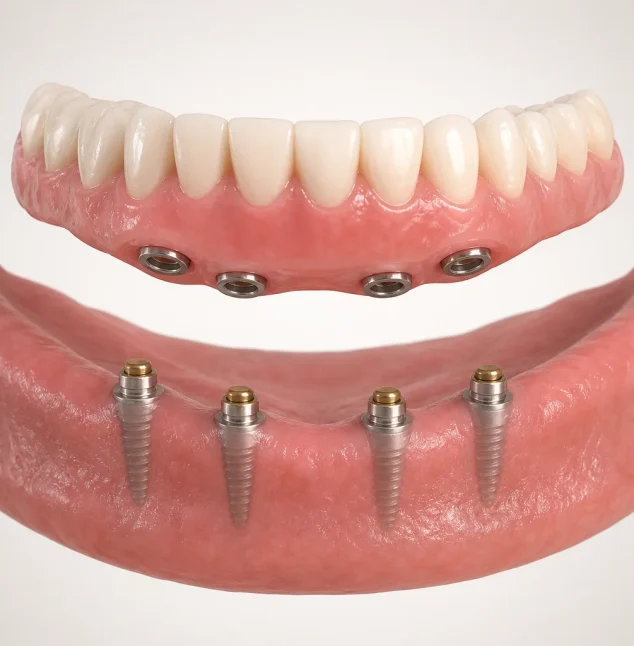
If a conventional denture feels loose or limits what you can eat, dental implants may provide a more secure foundation. An implant-supported denture attaches to implants in the jaw instead of relying only on suction, adhesive, and the shape of the gums.
What Is an Implant-Supported Denture?
An implant-supported denture—often called a snap-in denture or implant overdenture—is a removable full denture that connects to small attachments on dental implants. You can take it out for daily cleaning, but when it is seated, the attachments help resist lifting, rocking, and sliding.
The number and location of implants are planned for the individual arch. A lower overdenture may sometimes use two implants, while other lower and upper designs commonly use more. Bone anatomy, bite forces, the condition of an existing denture, cleaning ability, and the planned restoration all influence the design.
Removable security—not a fixed bridge
This page focuses on removable implant overdentures. A fixed full-arch restoration stays in the mouth and can be removed only by a dental professional. If you prefer a fixed option, read about our All-on-X full-arch solutions.
Why Patients Consider Implant-Supported Dentures
More dependable stability
Implant attachments can reduce the movement that conventional dentures may have during speaking, laughing, and chewing.
Improved function
A steadier denture may make a wider range of foods easier to manage, although chewing ability and dietary guidance vary by patient.
Easier daily removal
The denture comes out for thorough cleaning, which can be helpful for patients who prefer a removable design or need added lip and facial support.
Support for the jaw
Implants transfer force to the surrounding bone and can help preserve bone near the implants, though normal bone and tissue changes can still occur over time.
Implant-Supported vs. Conventional Dentures
| Feature | Conventional full denture | Removable implant-supported denture |
|---|---|---|
| How it stays in place | Rests on the gums and may depend on suction or adhesive | Connects to attachments secured to implants |
| Daily removal | Yes | Yes |
| Movement | May rock or lift as the ridge changes | Usually more resistant to lifting and sliding |
| Cleaning | Brush the denture and clean the gums | Brush the denture, attachments, implants, gums, and tongue |
| Maintenance | Relines, adjustments, repairs, and eventual replacement may be needed | The denture and attachment inserts can wear and need adjustment or replacement; implants also require professional monitoring |
Your Treatment Path at Oak Hill Family Dentistry
Treatment starts with a comprehensive dental examination, a review of your health and medications, and a discussion of what is and is not working with your current teeth or denture. When appropriate, our office uses 3D cone-beam CT imaging to evaluate bone volume, implant positions, nerves, sinuses, and restorative space.
Evaluate and plan
We assess your teeth, gums, bite, bone, medical history, and goals. We also discuss conventional dentures, fixed full-arch treatment, and whether preserving any natural teeth is possible.
Prepare the mouth
Any active gum infection or decay must be addressed. Some patients need extractions or bone grafting; others can proceed without grafting.
Place and heal implants
Implants are placed in planned positions and allowed to integrate with the jaw. A temporary or adjusted denture may be used while the tissues heal.
Connect and fine-tune
After appropriate healing, the final attachments and denture are fitted. We check retention, bite, speech, appearance, comfort, and your ability to remove and clean it.
Who May Be a Candidate?
Implant-supported dentures may be considered for adults who are missing all—or are expected to lose all—teeth in an arch and want more stability than a conventional denture. Candidacy depends on healthy enough oral tissues, adequate bone or a grafting option, realistic expectations, and the ability to perform daily hygiene and attend maintenance visits.
Smoking, uncontrolled diabetes, active gum disease, certain medications, immune or bone-healing conditions, and heavy bite forces can increase risk or change the plan. These factors do not all create an automatic “no,” but they require an honest, individualized assessment and sometimes coordination with your physician or a dental specialist.
Daily Care and Long-Term Maintenance
- Remove and clean the denture as instructed, usually at least morning and night.
- Clean around every implant attachment and along the gums with the tools recommended for your design.
- Do not use hot water, abrasive household cleaners, or force the denture if it does not seat normally.
- Follow your dentist’s instructions about overnight wear; many removable dentures should be left out while sleeping to give tissues a rest.
- Keep regular professional examinations and cleanings. Attachment inserts, denture teeth, acrylic, and other components are expected to wear and may need service.
Explore a More Secure Denture in Newnan
Dr. Mike Jin can compare conventional dentures, removable implant overdentures, and fixed full-arch options using your examination and 3D images—not a one-size-fits-all recommendation.
Patient information: This page provides general education and is not a diagnosis or guarantee of candidacy, timing, comfort, cost, or outcome. Recommendations can be made only after an in-person examination and appropriate imaging.
Implant-Supported Denture FAQs
An implant-supported denture is a full-arch prosthesis that uses dental implants for added retention and support. A removable version snaps onto attachments and is taken out by the patient for cleaning; a fixed full-arch restoration is a different design that only a dental professional removes.
The snap-in overdentures discussed on this page are removable. You remove them daily to clean the denture, implant attachments, gums, and tongue, then seat them again by aligning the attachments and applying gentle, even pressure.
There is no safe universal number. Some lower overdentures can be designed around two implants, while other lower and upper restorations often use more; bone anatomy, bite forces, restorative space, and the planned attachment system determine the number and position.
A conventional denture rests on the gums and may rely on suction or adhesive. A snap-in denture connects to implant attachments, so it is generally more resistant to lifting and sliding, but it still comes out for cleaning and still requires maintenance.
Not usually. Implant-supported denture often refers to a removable overdenture, while All-on-X commonly describes a fixed full-arch bridge supported by several implants; the right option depends on anatomy, hygiene ability, facial support, goals, and budget.
Possible candidates are missing all or nearly all teeth in an arch, have oral tissues healthy enough for treatment, and can maintain daily hygiene and follow-up care. A clinical examination, medical review, and 3D imaging are needed because bone, gum disease, smoking, diabetes control, medications, and bite forces can change risk and treatment design.
Some patients have enough bone for a planned overdenture without grafting, while others need grafting or a different implant design. Cone-beam CT imaging helps determine bone height, width, and important anatomy before a recommendation is made.
Treatment commonly spans several months because implants need time to integrate with the jaw, and grafting can add healing time. The schedule also depends on extractions, tissue healing, whether an existing denture can be adapted temporarily, and when the final denture is made.
Sometimes an existing denture can be adapted, but only if its fit, strength, tooth position, bite, and restorative space are suitable. Many patients receive a new prosthesis designed specifically for the implant locations and attachments.
Many patients find a more stable denture improves chewing confidence and allows a broader diet than a loose conventional denture. You will still need a staged diet during healing, and very hard or sticky foods may need to be limited depending on the prosthesis and bite.
Remove the denture and clean all surfaces with a denture brush and a dentist-recommended cleanser. Carefully clean around each attachment and along the gums with a soft brush or other recommended aids, and attend professional implant-maintenance visits even if everything feels comfortable.
Follow the instructions for your specific design. Many removable dentures should be left out overnight so the tissues can rest and the prosthesis can be cleaned, but individual medical or functional needs can change that advice.
Yes. The small retention inserts and other denture components are designed to be serviced and can wear with use, causing the denture to feel looser; professional adjustment or replacement of inserts can restore retention in many cases.
Risks can include pain, swelling, infection, nerve or sinus injury, failure of an implant to integrate, gum or bone loss around implants, and wear or fracture of denture components. Your examination and consent discussion should address risks specific to your health, anatomy, and planned design.
Cost varies with the number of implants, extractions or grafting, attachment system, laboratory work, temporary prosthesis, and final denture. Dental insurance may cover portions but often has limits or exclusions; Oak Hill can provide an itemized estimate and discuss available financing after a personalized treatment plan.